


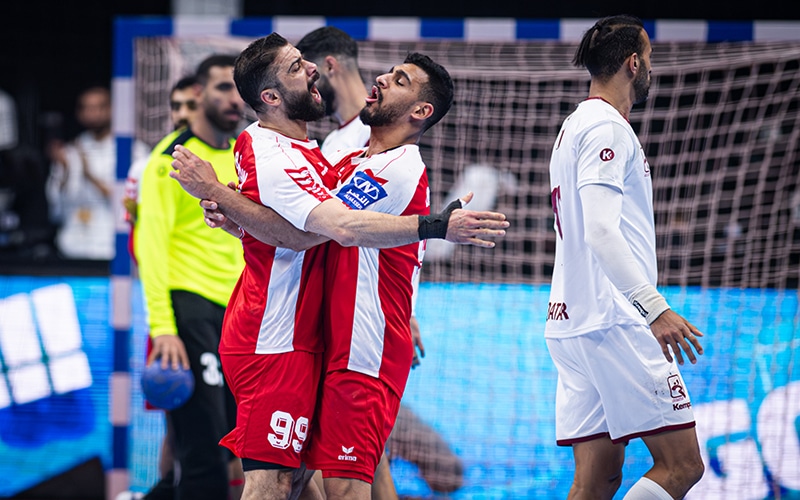
To say Qatar and Bahrain men’s teams are familiar with each other on the continental stage is an understatement. And to say Qatar have been Bahrain’s nemesis at the Asian event is not an understatement either.
Held every two years, the AHF Men’s Asian Championship has seen Bahrain lose to Qatar in the 2014, 2016, 2018 and 2022 finals, plus a 2020 semi-final loss to boot. In 2024, the two teams did not meet, but Qatar won and then host nation Bahrain took bronze.
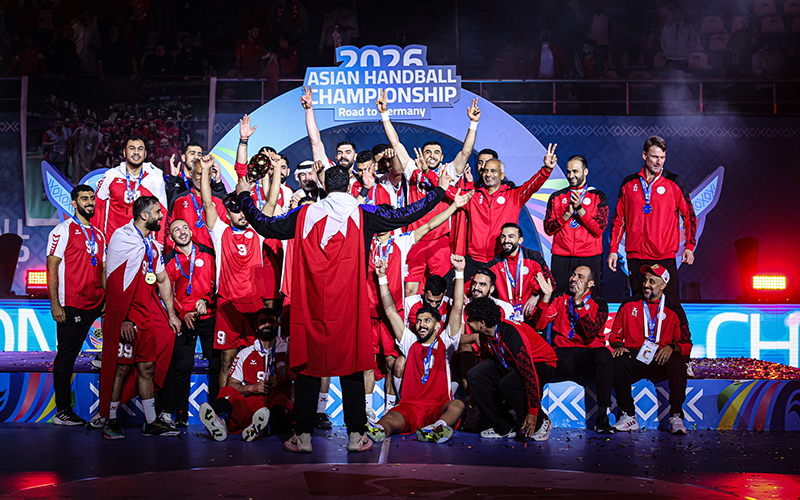
But this January, Bahrain finally prevailed – beating Qatar not once, but twice at the 2026 Asian Championships – firstly in the main round group stage and then again in the gold medal match.
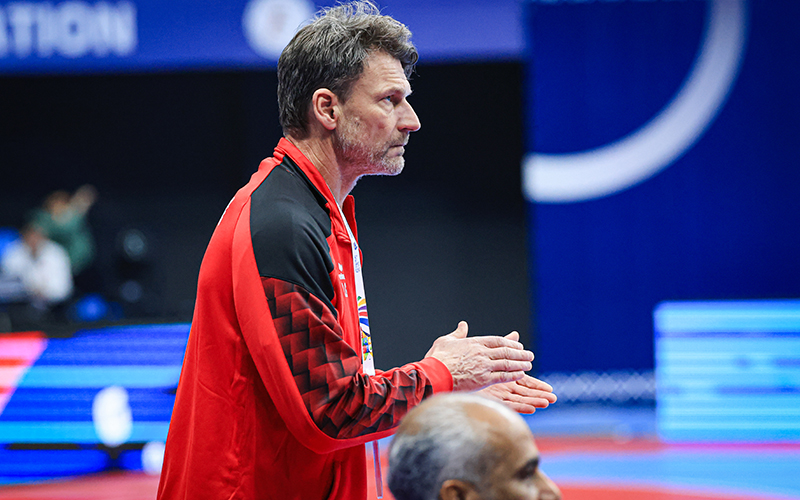
“It was incredible and very satisfying to see them succeed,” said Bahrain coach Robert Hedin about watching his 2026 side grab top spot for the first time in 19 attempts, to ihf.info. “In the past, when we won against Qatar it was always at the beginning of the competition and then we would always lose the final to them, but we knew we had a chance this time. We knew what to do: we had to find something extra.
“To see how happy they were to win – even my boss Ismail was crying after the game – I really understood how important it was for them to finally get that win.”
An opportunity to create history
That success under Hedin can be traced back to May 2025, when it was announced by the Bahrain Handball Association (BHA) that the Swedish coach had been appointed as the new Bahrain men’s national team coach, following in the footsteps of three Icelandic coaches – Gudmundur Gudmundsson, Aron Kristjansson and Halldor Johann Sigfusson.
“Bahrain initially contacted me during the 2025 IHF Men’s World Championship, but I wanted to fulfil my work with the USA on the journey to the LA28 Olympic Games, however, some things changed at the federation which affected my role, so I stepped down,” he explained.
“I’d worked a lot in different places across Europe and Scandinavia, and America too, so I wanted to try something else: I wanted to experience and see a new culture and new handball players.
“What interested me was that they were changing the generation of players. They had a lot of older players previously and in 2025 there was a chance to introduce the younger generation. I like to take things on that are not already set; something where you can build and create something and I knew it would be a great experience for me.
“I did talk to Aron (Kristjansson) before accepting,” added the 60-year-old. “I wanted to check out how it was; the leadership, the players and the potential for the future. I wanted to check around and find out how it was to stay and live there and see if it was fine. Aron said they were nice people and took good care of him, so it made my choice easy.”
With three young children, aged 10, 11 and 15 years old, it was not possible for Hedin to spend all his time in Bahrain, so an agreement was reached for him to split his time between long periods in the Asian nation and back home.
“I knew I could not stay in Bahrain for three months in a row, but as long as I could go backwards and forwards between there and home, it was fine.”
First steps, first medal
After the May announcement of his new role, Hedin would spend a further two months in Europe before finally joining up with the team in Bahrain for two weeks in July.
“My very first impression in person was that I saw a lot of very, very, very good players and knew I definitely had something to build on. I could see their skills and that they were nice guys. It was almost the same as having a practice in Europe, so that was a good, good feeling,” said the coach, who played for clubs in Sweden, Spain, Switzerland and Germany before transitioning into a playing-coaching role at Swiss club side TSV St. Otmar St. Gallen (1998-2001).
It was also a feeling of relief for the coach, who had admitted he had been a “little worried” about the level of players having watched some club game previously.
“When I saw them in person, saw them in practice, I could see that I could definitely do something with them; with small adjustments, it could be really good.”
The first competitive test came in November, with the 2025 Islamic Solidarity Games in Saudi Arabia. Hedin and his side beat Qatar in the semi-finals and then saw off the hosts 33:31 in the final to take their first title in the competition.
“Ahead of the Islamic Games our first preparation day was 8th October and then I really saw the skills of the players and saw what we could do if we found the right mix,” explained Hedin, who went on to coach at German club teams TuS N.-Lübbecke and MT Melsungen, separated by a stint at former club Ystads IF (2004-07).
“Before the Islamic Solidarity Games, the first talk I had with the BHA was that the competition was the time to get new players in for the Asian Championships and there was pressure on that; to find the right mix. But four days before it started, we had a meeting and they said we have to win it. I remember thinking to myself, ‘How can that be? We have never won it and now we have to win it.’
“But it was a good test for us,” he continued. “My assistant coach Ali (Ameen Al Qallaf) was really good about telling me everything. We looked at the player skills, behaviour, how the captain worked, how can we play defence together, how we can practice this, the team construction – everything. It was a totally new culture for me; everything was different and everything was new.”
Small changes, big differences
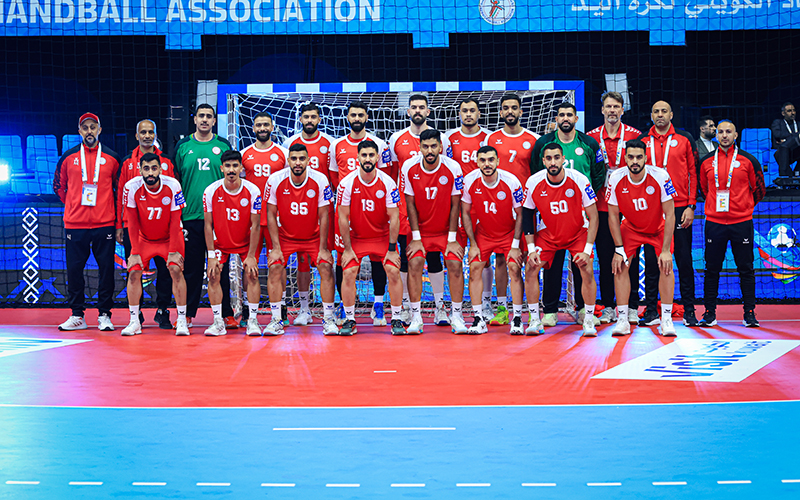
Early on in Saudi Arabia, Hedin realised what formula he was going to use, but he had to work hard to implement his vision and this pathway to success.
“After one or two games I knew how to play and how I wanted to do it. I wanted to do it as easily as possible, so we didn’t have to switch so many things. If opponents did other things, we don’t have to switch too much. I have rules for this; one or two things. If they do it ‘like that’, we do it ‘like this’, but it was small changes,” said the coach who won European gold in 1994, silver at the Barcelona 1992 and Atlanta 1996 Olympic Games, and bronze at the 1993 IHF Men’s World Championship as a player with Sweden.
“In defence, I have a system that’s quite easy to implement, but in attack we were almost doing the same thing every time. It was easy for our opponents to see, so I tried to change the rhythms, but it was not because the players were not used to it. They wanted to go 1v1 every time. They were not used to crossing, and they did not have the ‘flow’, so we had to switch; I had to feel their mindsets and they mine.
“I said to them, ‘You cannot play like how you want to, but I will find the best way for the team.’ Even if it was an easy system, I had questions not only from the players but from everyone else around the team. I would say in the early days my role was 20% coaching and 80% off-court management – I had to explain and discuss everything. It was an experience, but it was easier working with our defence than attack.
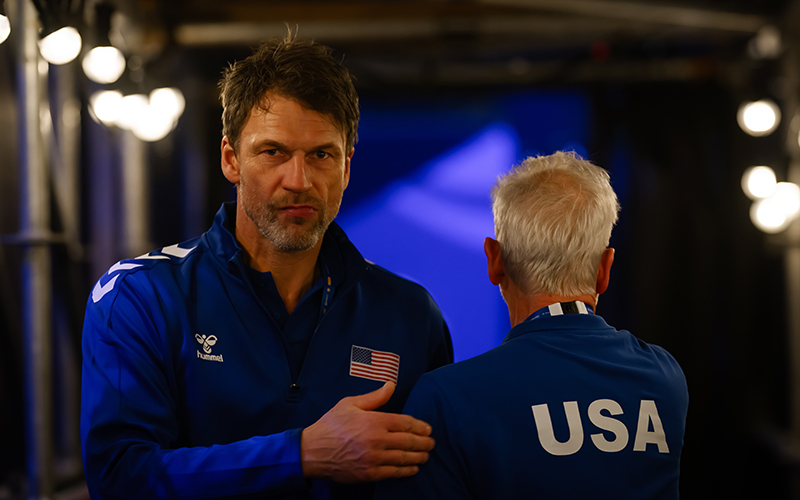
“I did a lot of work with Hussain Al Sayyad, our captain. He’s a really, really good player, but he came a little bit later to our Islamic Solidarity Games camp because he was playing in the Saudi Arabian league,” explained Hedin, who coached the USA men’s national team (2018-25), overseeing their first win at an IHF Men’s World Championship in 2023, three more wins at the 2025 edition and securing bronze at the 2025 IHF Men’s Emerging Nations Championship.
“I didn’t involve him so much in the beginning, but this caused a little bit of a problem as he was not used to not playing. I told him, ‘You’re the best player and you will play the important games.’ So, maybe, he was a little bit unsure about me. It was a problem you had to solve. The captaincy is not the same as it is in Europe, so I had to understand how it worked and find a solution.
“In the end, we did a good job together, even if we had some problems in the beginning and the end, the Islamic Solidarity Games were an important period for us as a team as, after that, it was normal work.”
A break and reflection before history made in Kuwait
With the Islamic Solidarity Games finishing in late November, Hedin took time to go home and reset before a busy preparation period in December and January.
“We then had to find some good opponents before the Asian Championships,” he explained. “So we went to Portugal, played them twice and then went to Switzerland for the Yellow Cup – these were important preparation games for us because we could see where our deficits were and maybe change some small things.”
Portugal – who finished fourth at the 2025 IHF Men’s World Championship and would finish fifth at the subsequent 2026 EHF Men’s European Championship – proved a tough test with Bahrain losing 39:29 and 40:28, while the Yellow Cup saw losses against three European Championship-bound teams in North Macedonia (32:28), Switzerland (33:30) and Ukraine (32:20).
Hedin and his Bahrain team certainly learned a lot across those five match days in just a six-day period, but there was no more rest – as the continental extravaganza awaited.
Bahrain opened their 2016 campaign in Kuwait with three preliminary group wins: against Jordan (32:21), People’s Republic of China (40:29) and Iraq (34:18).
They followed up in the main round with wins against the United Arab Emirates (32:20) and that important first victory against reigning champions Qatar (31:28).
But Saudi Arabia quickly brought them down to earth, defeating them 23:21 in the final main round group game, which saw them end on equal points (4) with both the Saudis and Qataris, but thanks to a better goal difference, they took one of the two semi-final spots.
“We knew before the Saudi game that we could lose by five goals and we were in the lead the whole game until the last seven or eight minutes,” explained Hedin about that Saudi loss. “We wanted to win and do our best, but, in a way, it was probably the best thing to do to lose to them, as it was a good practice for the semi-final – we had struggled with Saudi Arabia before to win.”
A dominant 35:25 victory over Japan in the semi-final then followed.
“It was a good semi-final for us,” said the coach. “It gave us self-confidence and everything. The match was a little bit scary at the beginning as Japan had played some good games, but we knew we could do it and, in the end, we just got a grip of the game and easily won it.”
That result set up yet another final against Qatar, but this time it was different, just.
“At the beginning of the game everybody believed that we could win, but we knew it would be difficult to win a second game against Qatar in the competition,” said Hedin.
And so it proved to be, initially, as Bahrain squandered a two-goal lead just moments before the final whistle, including a missed seven-metre to seal victory, as Qatar drew even at 24:24 with just seconds remaining to take the game to additional time.
“There was no time to motivate him,” said Hedin about talking to player Mohamed Habib Ahmed after seeing his seven-metre saved with 32 seconds left, which would have put his side 25:23 clear for the victory.
“I had to motivate the team to believe in what we were doing, as at the break before additional time started, everybody was looking at the floor. You saw zero confidence in them when I was talking and I said to them, ‘You have to believe in this’, but they just looked at me like there was no chance. In the end, we managed to change it.”
Starting with possession, Bahrain opened the scoring through Salman Al-Showaikh on the wing early on to make it 25:24 before a strong defence saw the ball turned over to Bahrain by Qatar and Jasim Khamis shot from distance, breaking through to make it 26:24.
Goalkeeper Mohamed Abdulhusain Ali then saved a seven-metre from Qatar captain Ahmad Madadi and after a turnover from each side, Mohamed Naser Mohamed sunk home just before the end of the additional period to make it 27:24, a late Madadi seven-metre making it 27:25 to Bahrain at the break.
And with just over two minutes remaining in the second half of additional time, Bahrain were already celebrating on court and their fans off court, with the side 29:25 up.
“It was a good start, scoring 3:0,” said the coach, who has also coached the Norway men’s national team (2008-14), Danish side Aalborg Handbold and Austrian side Bregenz Handball.
“It was important we started in attack, or we scored the first goal, as that gave us confidence. If Qatar had scored first and we were having to hunt the whole time, I think it would have been impossible to win, but we scored and Qatar missed, and then we scored again: suddenly, everybody started believing again.”
And as soon as that final whistle sounded, captain Hussain Al Sayyad broke down in tears, prompting the rest of the Bahrain squad and backroom staff to do the same.
“The players were running around and carrying each other on their shoulders. For me, it’s always important to win a game if it’s a test game or a tournament, but I saw that this was something extra for them and that was a nice feeling as coach to see,” said Hedin.
“There were people from Bahrain everywhere, and I recognised some of the former players were there too and congratulating us – I then realised how big it was. I also had a lot of friends and European players and coaches congratulating me too. They were following the competition while at the European Championship, which I didn’t realise in the beginning.”
Before the trophy presentation, centre back Mohamed Naser Mohamed and right wing Al-Showaikh were presented with All-star Team awards and then the celebrations could begin for his squad – Hedin himself was calm and collected at the back of the stage, even taking time to film his squad on stage with his phone, knowing that he was due to leave Kuwait soon.
“I didn’t have much time for celebrations as I was due to travel back home to see my family and my dog, Milo, too, as I hadn’t seen them since Christmas, plus to celebrate my birthday,” said Hedin.
“About half an hour before I went to take the taxi to the airport, I was told that His Majesty King Hamad bin Isa Al Khalifa, the King of Bahrain wanted to meet us, but I couldn’t switch my flight. The players went back to Bahrain and celebrated at the airport. It would have been amazing to have met the king, but my job was done – to win the Asian Championships – they had achieved it and everyone in Bahrain was happy about it.”
Growing and learning
After signing a two-year contract in 2025, with a possible one-year extension should his side qualify for the Los Angeles 2028 Olympic Games, Hedin is now fully focused on the upcoming 2026 Asian Games and 2027 IHF Men’s World Championship – qualification of which was secured by their ranking in Kuwait.
“It’s a very exciting time, but it’s also an important time where we now have a chance to get to know some new players in Bahrain who I think have great potential,” said the coach about his next steps with the national team.
“I’m looking forward to integrating them into the team and finding the right mix between the old and young guys so we can play a little bit of a different attacking system, switching and maybe giving the young players some moments to change the rhythms while still taking advantage of the knowledge and experience from our more experienced players.
“I’ve learned a lot,” he added about his experience so far. “To put words on that is difficult. I talked to Aron (Kristjansson) and he said ‘This is something that’s really hard to explain – you have to live in it to explain it.’ It’s a great experience, but if I was 20 years younger, I probably wouldn’t have survived it. Now, as I am older and have seen a lot, I am able to make compromises and it makes it easier.
“It’s been a huge personal development for me but it’s more than just one thing. It’s a way to see life. It’s how I live and how I meet people. I’ve been more outside Sweden than I’ve been in Sweden and for me it’s great to meet different people and experience a different culture. I’ve grown a lot as an individual person.
“It’s been an amazing experience. I’ve done the world championships with the USA and now I will get to do it again with Bahrain in Germany. For me, Germany is the best for fans and spectators. It will be an amazing atmosphere and I’m looking forward to that.”
Photo credit: Asian Handball Federation
